


SME Loans (Small and Medium Enterprises)
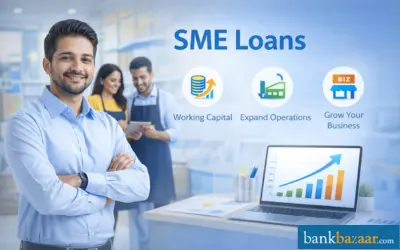
Loans which cater to the financial needs of the Small and Medium Enterprise (SME) segment are known as SME loans. This segment is responsible for providing huge employment opportunities at relatively lower capital costs and at the same time, also aids in industrialisation of backward and rural areas.
By contributing highly to domestic production, significantly increasing export earnings, and by being operationally flexible, SMEs play a key role in the development of the nation.
Top Banks Offering SME Loans in India
Name of the Bank | Interest Rate | Loan Amount | Repayment Tenure |
State Bank of India | 9.55% onwards | Up to Rs.500 lakh | Up to 7 years |
Axis Bank | Based on business profile | Up to Rs.5 crore | Up to 60 months |
Tata Capital | 16% p.a. onwards | Up to Rs.90 lakh | Up to 60 months |
YES Bank | - | At the discretion of the bank | - |
Karur Vysya Bank | Linked to Credit Score | - | Up to 7 years |
HDFC Bank | 7.65% p.a. onwards | Up to Rs.50 lakh | Up to 180 months |
Aditya Birla Capital | - | Up to Rs.1 crore | Up to 48 months |
Mahindra Finance | 8% to 21% | Up to Rs.25 lakh | Up to 60 months |
Advantages of SME Loan
The advantages of SME Loan are given below:
- SME loans offer adaptable repayment periods spanning from 12 to 60 months, eliminating the necessity for collateral.
- The application process is swift and straightforward, facilitated through online channels, resulting in a shorter approval duration.
- Additionally, minimal documentation is required, streamlining the overall lending process for small and medium enterprises.
Fees and Interest Rates
Processing Fees: Various lenders may present SME loans with distinct processing fees. It is advisable to opt for a lender that offers the loan with a minimal processing fee.
Interest Rates: The interest rate can fluctuate depending on the chosen loan scheme and financial institution. Lenders often consider factors such as collateral, loan amount, tenure, applicant's creditworthiness, repayment capacity, and existing loans. Typically, interest rates may vary from 7.65% p.a. to 21% p.a.
Eligibility Criteria for SME Loans
The eligibility criteria for SME loans may vary from lender to lender but in general, most lenders look for the below-given eligibility criteria:
Who can apply | Proprietors, self-employed individuals, partnership firms, private limited companies engaged in the business of trading, manufacturing, and services |
Age of the borrower |
|
Minimum Annual Income of the Business | Rs.1.5 lakh |
Minimum Turnover of the Business | Rs.40 lakh |
Profit Status of the Business | Should have been making profits for the last 2 years |
Business Experience | Borrowers should have been in the same line of business for at least 3 years and have at least 5 years of total business experience |
Documents Required for Availing SME Loans
When applying for an SME loan, you will be asked to furnish the below-given documents:
Identity Proof | passport, Aadhaar Card, Driving License, Voter's ID, PAN Card, etc. |
Address Proof | Aadhar Card, Passport, Voter's ID, Driving License, etc. |
Proof of Business | Business Entity Proof, Partnership Deed, Incorporation Certificate, Shops and Establishment Certificate, Articles of Association |
PAN Card | Of business entity and of partners/promotors |
Company Financials | Provisional/audited financials - tax audit reports, balance sheet, profit and loss, VAT returns, etc., for the last 3 years |
Bank Statements | For the last six months |
Application Form | Duly filled and signed |
Please note that based on the type of applicant (whether partnership firm or individual), nature of business, income profile of the applicant, etc., the lender may ask for additional documents.
How to Apply for SME Loan?
After selecting the lender for your SME loan application, you will need to obtain the SME loan application form from the chosen lender. The application form typically requires the following information:
- Company name
- Date of incorporation
- Registered address of the company
- Operating address of the company
- Contact number and email address of the company
- Industry code
- Permanent Account Number (PAN)
- GST number
Dos and Don'ts Before Applying for SME Loans
Dos
- Compare Financial Institutions: Don't settle for the first lender you come across when applying for an MSME loan for new businesses. Different financial institutions offer varying loan terms, conditions, and interest rates. To ensure the best fit for your business, carefully compare these features among different lenders.
- Have a Plan and Gather Required Documents: Before approaching a financial institution, it's crucial to have a well-thought-out business plan. This plan will not only help you determine the appropriate loan amount and conditions but will also serve as a tool for the lender to understand your business's revenue model. Ensure all necessary business documents are ready to facilitate a smooth loan application process.
- Assess Your Financial Needs: Conduct a thorough review of your budget and analyze your financial forecast before applying for a startup loan for new businesses. Understanding your financial situation will help you determine whether it's the right time to take a loan. For example, if you have new investors coming on board, taking a loan might only increase your debt without providing substantial value.
Dont’s
- Avoid Fixating on Low-Interest Rates: While a low-interest rate is undoubtedly appealing, it should not be your sole criterion for selecting a loan. Instead, consider a holistic approach, considering factors such as the loan term, lender policies, overhead charges, benefits, and more. This comprehensive evaluation will provide you with a clearer picture and enable you to make an informed decision.
- Avoid Repaying the Loan Too Quickly: For a growing business, it's advisable to avoid repaying the loan too quickly. Despite having generated sufficient revenue to settle the loan comfortably, the uncertain nature of the business world suggests keeping funds reserved for unforeseen circumstances. Additionally, premature repayment might incur foreclosure charges, increasing the overall repayment amount.
- Avoid Applying with Multiple Lenders Simultaneously: While the prospect of obtaining a larger financial influx with multiple loans may be tempting, refrain from applying with more than one lender simultaneously. This practice can adversely affect your credit score and potentially hinder future loan applications.
Top 5 Government SME Loan schemes in India
Some of the top Government SME Loan schemes in India are given below:
1. Pradhan Mantri MUDRA Yojana (PMMY)
2. National Small Industries Corporation
3. MSME Loan Scheme in 59 Minutes
4. SIDBI Loan
5. Credit-Linked Capital Subsidy Scheme
Pradhan Mantri Mudra Yojana (PMMY)
Pradhan Mantri MUDRA Yojana (PMMY) is another excellent government loan scheme, especially beneficial for women entrepreneurs and businesses involved in services and trading.
MUDRA, an acronym for Micro Units Development and Refinance Agency Ltd., serves as a refinancing support system for banks and NBFCs providing credit to small businesses.
The scheme offers collateral-free credit, allowing borrowers the flexibility to extend the repayment period.
Under the MUDRA loan scheme, three types of loans are provided:
- Shishu MUDRA Loan:
- Principal Amount: Up to Rs 50,000
- Kishor MUDRA Loan:
- Principal Amount: Up to Rs 5 lakhs
- Tarun MUDRA Loan:
- Principal Amount: Loans from Rs 5 lakhs to Rs 10 lakhs
Note: The rate of interest for RRBs and NBFCs have capped at 3.50% and 8.00% above Mudra refinance rate, respectively.
National Small Industries Corporation
This scheme is a boon for entrepreneurs seeking financial assistance in areas such as technology, marketing, finance, etc. It is often considered one of the best government schemes for business owners.
NSIC offers the following two schemes:
- Marketing Support Scheme:
- Businesses can benefit from marketing support through Consortia schemes, Tender Marketing, etc., aiding in business promotion, marketing, and expanding market reach.
- Credit Support Scheme:
- Under this scheme, financial assistance can be availed for procuring raw materials, finances, marketing, etc.
MSME Loan Scheme in 59 Minutes
- To address the working capital needs of MSME businesses, the Indian government introduced the MSME Loan Scheme. Under this entrepreneur loan scheme, both new and existing enterprises can access a loan of up to Rs.1 crore.
- The loan processing typically takes 8-12 days, with application approval/disapproval in just 59 minutes. Additionally, businesses can avail the loan at an 8% interest rate, and women entrepreneurs benefit from a 3% reservation under this scheme.
SIDBI Loan
- SIDBI, or Small Industries Development Bank of India, is one of the oldest entities offering government business loans. It mainly assists MSME businesses in need of funds, providing direct and indirect loan schemes to NBFCs and SFBs.
- Notably, SIDBI offers loans ranging from Rs10 lakh to Rs.25 crores, with a loan period of up to 10 years. A significant feature is that a loan of Rs.1 crore can be obtained through SIDBI without any collateral.
Credit-Linked Capital Subsidy Scheme
- This government subsidy loan for businesses is ideal for those requiring finance for technological advancements in industries, including marketing, supply chain, and manufacturing.
- Eligibility extends to partnership firms, private or public limited companies, sole proprietorships, and cooperative companies. Those opting for this business loan scheme receive an upfront capital subsidy of 15%.



FAQs on SME Loans
1.How can I repay my SME loan?
There are many ways by which you can make the repayment of your SME loan. They are postdated cheques (PDCs), Electronic Clearing Service (ECS), Standing Instruction (SI), direct debit, and National Automated Clearing House (NACH). The preferred mode of repayment can vary from lender to lender. The repayment can be done in equated monthly instalments (EMIs) which can be calculated by using the EMI Calculator tool.
2.What is a dropline overdraft facility?
The facility offered by lenders wherein borrowers can withdraw extra money from their business current account is known as an overdraft facility. It works as a short-term loan. Dropline overdraft facility is when the overdraft is taken for a longer term (maximum 10 years) but does not require annual renewals or attract yearly charges. The money withdrawn using the dropline overdraft facility can be used in the expansion of business or working capital.
3.Can I prepay my SME loan?
Yes. Most lenders will allow you to prepay your SME loan but will charge you a prepayment penalty. However, there are some lenders who do not charge any penalty for foreclosing or prepaying your SME loan. One such lender is Mahindra Finance.
4.Can I get an SME loan without providing any collateral?
A majority of lenders will ask for a collateral or security for an SME loan. However, there are some lenders such as IIFL Finance, State Bank of India (scheme-based), etc., who do not require you to provide a collateral for an SME loan.
5.What is bill discounting?
When the sales bills of reputed consumers are discounted leading to a reduction of the cash cycle of the business, it is known as bill discounting. It helps free up cash that the business can utilise for funding its operations, as working capital, and fulfil any other financial requirements.
6.If I wish to avail a lease rental discounting loan, what security do I need to provide?
To avail a lease rental discounting loan, the property against which the lease rentals have been discounted can be provided as security.
7.What is the maximum amount of loan I can avail under the Pradhan Manti Mudra Yojana (PMMY)?
You can avail loans ranging between Rs.50,000 and Rs.10 lakh under the PMMY to finance your small business enterprise in trading, manufacturing, and services sectors. Agriculture and its allied activities are also covered under the Mudra loan.
8.I am a doctor. Am I eligible for an SME loan?
Yes. Under the 'Doctor Plus' scheme offered by State Bank of India, you can avail SME loans ranging between Rs.10 lakh and Rs.5 crore to buy medical equipment, setting up your own clinic/nursing home/drug store, etc., and to expand your existing medical business. The repayment tenure for this loan ranges from 3 years to 7 years.
9.Is there a special SME loan for women entrepreneurs?
Women entrepreneurs can avail SME loans under a special scheme known as 'Stand-Up India' scheme. Under this scheme, women entrepreneurs can get finance from Rs.10 lakh to Rs.1 crore to set up a greenfield project. The repayment of this loan can be done in a maximum of 7 years. The scheme can also be availed by people belonging to the Scheduled Caste and Scheduled Tribe category.
10.I wish to set up my own fashion boutique. Can I get an SME loan for that?
Yes. Any business that generates income is eligible for an SME loan under the Pradhan Mantri Mudra Yojana. Since a fashion boutique is an income generating business, you can definitely avail the Mudra loan.
Personal Loans by Bank
- SBI Personal Loan
- HDFC Personal Loan
- IDFC First Personal Loan
- Kotak Personal Loan
- Axis Personal Loan
- Yes Bank Personal Loan
- IDBI Personal Loan
- Indusind Personal Loan
- Standard Chartered Personal Loan
- RBL Personal Loan
- Indian Bank Personal Loan
- Canara Bank Personal Loan
- Bank of Baroda Personal Loan
- Bank of India Personal Loan
- Central Bank of India Personal Loan
- Punjab National Bank Personal Loan
- Union Bank Personal Loan
- IOB Personal Loan
- Bank of Maharashtra Personal loan
- UCO Bank Personal Loan
- Punjab and Sind Bank Personal Loan
Personal Loan Eligibility by Banks
- SBI Personal Loan Eligibility
- HDFC Personal Loan Eligibility
- Kotak Personal Loan Eligibility
- Axis Bank Personal Loan Eligibility
- SCB Personal Loan Eligibility
- Tata Capital Personal Loan Eligibility
- IDBI Bank Personal Loan Eligibility
- Indusind Personal Loan Eligibility
- RBL Personal Loan Eligibility
- Yes Bank Personal Loan Eligibility
- Canara Bank Personal Loan Eligibility
- Bank of Baroda Personal Loan Eligibility
- PNB Personal Loan Eligibility
- IOB Personal Loan Eligibility
- Union Bank Personal Loan Eligibility
- Central Bank of India Personal Loan Eligibility
- UCO Bank Personal Loan Eligibility
- Bank of India Personal Loan Eligibility
- Bank of Maharashtra Personal Loan Eligibility
Personal Loan Interest Rates by Bank
- HDFC Personal Loan Interest Rates
- Kotak Personal Loan Interest Rates
- SBI Personal Loan Interest Rates
- Axis Bank Personal Loan Interest Rates
- SCB Personal Loan Interest rates
- Tata Capital Personal Loan Interest rates
- RBL Bank Personal Loan Interest rates
- YES Bank Personal Loan Interest rates
- Canara Bank Personal Loan Interest Rates
- Bank of Baroda Personal Loan Interest Rates
- Punjab National Bank Personal Loan Interest rates
Personal Loan EMI Calculator by Bank
- HDFC Personal Loan EMI Calculator
- AXIS Bank Personal Loan EMI Calculator
- Kotak Personal Loan EMI Calculator
- SCB Personal Loan EMI Calculator
- SBI Personal Loan EMI Calculator
- TATA Capital Personal Loan EMI Calculator
- YES Bank Personal Loan EMI Calculator
- PNB Personal Loan EMI Calculator
- Canara Bank Personal Loan EMI Calculator
Personal Loan Customer Care by Bank
- SBI Personal Loan Customer Care
- HDFC Personal Loan Customer Care
- IDFC First Personal Loan Customer Care
- Kotak Personal Loan Customer Care
- Axis Bank Personal Loan Customer Care
- TATA Capital Personal Loan Customer Care
- Shriram Finance Personal Loan Customer Care
- Indusind Personal Loan Customer Care
- Indiabulls Personal Loan Customer Care
- BOB Personal Loan Customer Care
- IIFL Bank Personal Loan Customer Care
- Yes Bank Personal Loan Customer Care
- RBL Personal Loan Customer Care
- Punjab National Personal Loan Customer Care
- Canara Personal Loan Customer Care
Personal Loan Status Track by Bank
- HDFC Bank Personal Loan Status
- IDFC First Personal Loan Status
- Yes Bank Personal Loan Status
- Tata Capital Personal Loan Status
- Axis Bank Personal Loan Status
- KOTAK Bank Personal Loan Status
- IndusInd Personal Loan Status
- SBI Bank Personal Loan Status
- PNB Bank Personal Loan Status
- Canara Bank Personal Loan Status
- Mahindra Finance Personal Loan Status
Personal Loan Articles
- Top Personal loan Finance Companies
- Personal Loan without Documents
- Personal Loan Verification Process
- Personal Loan Disbursal Process
- Personal Loan Preclosure Procedure
- Personal Loan for NRI
- Personal Loan Prepayment
- Pre Approved Personal Loan
- Personal Loan for Non Listed Companies
- Personal Loans by Private Sector Banks
- Microfinance Institutions
- Financial Inclusion Schemes in India
- Process of Bank Guarantee
- Promissory Notes
- Credit Appraisal
- Project Financing
- Statutory Liquidity Ratio
- Marginal Standing Facility
- Personal Loan Preclosure Calculator
- HDFC Bank Personal Loan Preclosure
Other Loans
- Mudra Loan
- Mortgage Loan
- MSME Loan
- Buy Now Pay Later
- Instant Loan
- NABARD
- SIDBI
- SKS Microfinance
- Agriculture Loan
- Business Start up Loan
- Marksheet Loan
- Loans For Unemployed
- Personal Loan for Low Salary
- Personal Loans by NBFCs
- Personal Loan for Govt Employees
- Personal Loan on Aadhar Card
- Personal Loan Insurance Plans
- Personal Loan Top Up
- Personal Loan for Salaried Employees
- Personal Loan for Self Employed

Disclaimer
Credit Card:
Credit Score:
Personal Loan:
Home Loan:
Fixed Deposit:


Copyright © 2026 BankBazaar.com.