


Cost Inflation Index - All You Need to Know about CII
The Cost Inflation Index (CII) is an annual government figure that adjusts the purchase price of long-term capital assets for inflation, ensuring taxpayers pay tax only on real profit, not inflation gains. The CII for FY 2025-26 is 376. Taxpayers use CII to calculate fair capital gains tax on property, shares, and other long-term assets.
What is Cost Inflation Index?
The Cost Inflation Index (CII) is a means to measure inflation, which is used in the computation of long-term capital gains concerning the sale of assets. Cost inflation takes into account the Consumer Price Index (CPI) for a given year for urban non-manual employees for the preceding year.
The cost of goods and services tends to rise due to inflation, which reduces the purchasing power of money. This means that the same amount of money buys fewer goods as time passes.
Thus, (CII) is a measure of price increase over time. It is used to establish the cost of long-term asset acquisition cost in calculating capital gains tax. The CII converts the original acquisition amount into current currency, so that tax is only payable on the real profit amount gained from an investment, and the effect of inflation does not become embedded in taxable income.
Example: Let’s say you purchased a piece of land in June 2012 (FY 2012-13) for Rs.1,00,000. The CII that year was 200. You sell the land in 2025 (FY 2025-26) for Rs.5,00,000, when the CII is 376.
- Step1: Adjust the purchase cost for inflation to account for inflation, multiply the original cost by the ratio of the CII of the sale year to the CII of the purchase year. Adjusted cost = 1,00,000 × (376 / 200) = Rs.1,88,000
- Step2: Calculate the capital gain Capital gain = Sale price – Adjusted cost Capital gain = 5,00,000 – 1,88,000 = Rs.3,12,000
- Step3: Benefit of using CII Without adjustment, the gain would have been Rs.4,00,000. Using CII reduces taxable gain to Rs.3,12,000, saving you tax on Rs.88,000.
What is the Purpose of Cost Inflation Index?
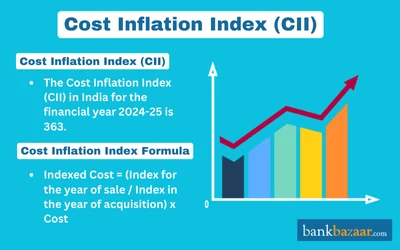
The Cost Inflation Index (CII), which allows for the derivation of a long-term capital asset.
It allows you to calculate capital gains on your assets using
- Property (real estate),
- Shares (market equities),
- Certain other capital items like land, stocks, and patents.
The issue is that you always record the asset on your books at its original purchase cost. If you sell your asset years later, your profit account can show an inflated profit because the prices of assets go up.
The CII scales back the original purchase cost to its inflation-adjusted amount; therefore, you only pay capital gains tax on the real profit. Reducing the original amount of the cost reduces any potentially taxable gain, which reduces potential taxes.
In 2018, the Central Board of Direct Taxes or CBDT revised the CII with a new base year of 2001 rather than 1981, and their CII set for 2001 was 100, which brought the CII rates and calculations forward with fairer values, particularly when calculating revised cost bases on gains for assets acquired prior to 1981.
Cost Inflation Index Table from FY 2001-02 to FY 2025-26
Check cost inflation index for financial year's CII Value:
Financial Year | Cost Inflation Index (CII) |
2025-2026 | 376 |
2024-2025 | 363 |
2023-2024 | 348 |
2022-2023 | 331 |
2021-2022 | 317 |
2020-2021 | 301 |
2019-2020 | 289 |
2018-2019 | 280 |
2017-2018 | 272 |
2016-2017 | 264 |
2015-2016 | 254 |
2014-2015 | 240 |
2013-2014 | 220 |
2012-2013 | 200 |
2011-2012 | 184 |
2010-2011 | 167 |
2009-2010 | 148 |
2008-2009 | 137 |
2007-2008 | 129 |
2006-2007 | 122 |
2005-2006 | 117 |
2004-2005 | 113 |
2003-2004 | 109 |
2002-2003 | 105 |
2001-2002 (Base Year) | 100 |
How to Calculate Cost Inflation Index?
The purchase price of the asset is indexed by the cost inflation index.
The formula to calculate the cost inflation index is as follows:
Cost Inflation Index (CII) = CII for the year the asset was transferred or sold / CII for the year the asset was acquired or bought
Example:
- Suppose, you purchased an apartment for Rs.20 lakhs in Jan 2000 and sold it for Rs.35 lakhs in Jan 2009. Your profit or capital gain is Rs.15 lakhs.
- The CII for the year the apartment was bought in is 389.
- The CII for the year the apartment was sold in is 582.
- Then, The cost inflation index is 582/389 = 1.49
- While computing tax, CII is multiplied with the purchase price to arrive at the indexed cost of acquisition. This is the actual cost of the asset.
- Therefore, the indexed cost of acquisition = Rs.20,00,000 X 1.49 = Rs.29,92,288
- The long term capital gain= sale value of the asset- indexed cost of acquisition i.e., Rs.35,00,00 – Rs.29,92,288 = Rs.5,07,712
- For assets (land/buildings) acquired before 23 July 2024, taxpayers may choose between a 20% rate with indexation or a 12.5% rate without indexation. For assets acquired on or after 23 July 2024, LTCG is taxed at 12.5% without indexation. In this example (asset acquired in 2000), using indexation: tax = 20% × Rs.5,07,712 = Rs.1,01,542. Without indexation: LTCG = Rs.35,00,000 – Rs.20,00,000 = Rs.15,00,000; tax = 12.5% × Rs.15,00,000 = Rs.1,87,500 (as of July 2024 amendment).
When you index, it helps you save taxes. It helps you adjust the purchasing price of the apartment with the current market prices.
Uses of Cost Inflation Index in Income Tax
Indexation is applied to the cost of asset acquisition in order to adjust asset prices in line with inflation. The formula for calculating the indexed cost of asset acquisition is as follows:
Indexed Cost of Asset Acquisition = (CII for the year of transfer or sale x Cost of asset acquisition)/CII for the first year of the asset's holding period or year 2001-2002, whichever occurs later
The formula to determine the indexed cost of asset improvement is as follows:
Indexed Cost of Asset Improvement = (CII for the year of transfer or sale x Cost of asset improvement)/CII for the year the asset improvement was made.
Importance of Cost Inflation Index (CII)
The significance of Cost Inflation Index (CII) is as follows:
- Ensures equitable taxation: Imposes tax only on the actual gain, realising that inflation must be accounted for even if this means nominal gains will not be taxed.
- Mitigates long-term capital gains tax: When indexation applies, the cost base is increased, thus providing a lower taxable profit which immediately affects the tax obligation.
- Provides clarity and consistency: Taxpayers and authorities now use an officially notified table of Cost Inflation Index providing a uniform methodology to determine gains and limits disputes over reasoning.
- Facilitates historical asset valuation: CII is useful to accurately compute gains in situations when the asset was acquired a sizeable time ago, especially for holdings pre-2001, the base year for Cost Inflation Index.
- Has application to inherited or gifted assets: CII uses the previous owner's year of acquisition to apply indexation, which remains equitable for taxation purposes.
- Assists in financial planning: Investors and their accountants can assess potential tax implications for long-term gains with accuracy.
- Lawfully accepted: Cost Inflation Index is notified by the Central Government, thereby legally providing standing for taxation of long-term capital gains.
Benefits of Cost Inflation Index
The major advantages of having a Cost Inflation Index are as follows:
- Lowers taxable capital gain: The legislation provides for a deduction of the indexed cost of acquisition or improvement (that is, using CII), reducing taxable long term capital gains from the full value of consideration.
- Accounts for real economic gain: The ‘indexed cost’ accounts for inflation, where the cost base is adjusted for inflation through the use of CII, not taxation based on nominal rather than real economic gain.
- Government approved and uniform: The CII table has been formally notified to the Gazette and is provided by the Income Tax Department. This ensures a legal, acceptable, uniform way for taxpayers.
- Easy calculation: The CII values in the official table provide taxpayers with an allowable standard factor for indexation, instead of taxpayers having to independently compute inflation.
- Non-resident Eligibility Exclusion: Non-resident individuals are not eligible for indexation benefit on long-term capital gains, reducing their tax advantage compared to residents.
How is CII Useful in Reducing Tax?
We saw in the earlier example that indexing helps us save a substantial amount of Income Tax that will be levied on the long term capital gain arising out of selling off your asset. But, indexation is not available for short term capital gain or losses. This benefit is also not available to Non-Resident Indians.
The indexation for long term capital gain is available only if you meet the following criteria:
- Cost of acquisition of the asset has to be multiplied with the cost of inflation of the year it was transferred.
- That figure is to be divided by the cost inflation index for the year in which the asset was acquired.
- If the asset was purchased before 1981, the cost inflation index of the year 1981 must be taken into consideration.
- If you have made improvement of the asset, then you need to adjust the cost inflation index with the multiplying with the CII of the year the improvement was made.
- CII is calculated by CBDT using 75% of the average Consumer Price Index (urban) for the preceding year, ensuring methodological consistency and official accuracy.
Things to Consider about Cost Inflation Index
Here are a few important considerations that assessees should make when determining their indexed cost of asset acquisition:
- If an asset is acquired through an assessee's will, CII is taken into account for that year. The asset's actual purchase year is not relevant in this situation.
- Except for sovereign gold bonds or capital indexation bonds issued by the Reserve Bank of India (RBI), the benefits of indexation cannot be applicable to debentures or bonds.
- Any improvement costs incurred prior to 1 April 2001 are not eligible for indexation.
Removal of Indexation Benefit
The government has eliminated the indexation benefit with effect from 23 July 2024, on long-term capital gains. As a result, investors can no longer adjust the purchase price of their assets for inflation when calculating capital gains tax. This change may lead to higher taxable gains and increased tax liability.
For land or buildings acquired before 23 July 2024, taxpayers can choose between:
- A 12.5% tax rate without indexation, or
- A 20% tax rate with indexation.
However, for land or buildings purchased on or after 23 July 2024, a 12.5% tax rate without indexation will apply to long-term assets.
FAQs on Cost Inflation Index
1.What is the meaning of CII in income tax?
Cost Inflation Index is an annual government measure used to adjust the original purchase price of long-term capital assets for inflation, ensuring that capital gains tax applies only to real profit rather than inflation-driven price increases.
2.What is Base Year in Cost Inflation Index?
The base year is the index's first year, with a value of 100. To monitor the rise in the inflation percentage in the years after the base year, the indexation of those years is done according to the base year.
3.What is the Consumer Price Index (CPI)?
The CPI measures the change in price of a fixed ‘basket of goods and services’, at a defined frequency, that reflects normal consumption in the economy. By measuring the current cost of the basket against the previous year, the CPI indicates price inflation.
4.Who Notifies the Cost Inflation Index?
The Central Board of Direct Taxes (CBDT), part of the Department of Revenue under the Ministry of Finance, Government of India, notifies the Cost Inflation Index annually in the Official Gazette.
5.What is the Reason for the Base Year to change from 1981 to 2001?
The base year was changed because taxpayers faced difficulty in determining accurate asset valuations purchased before 1981. The shift to 2001-02 as the base year (effective from FY 2017-18 onwards) made it easier to establish fair market values and simplified CII calculations.
6.Why is Cost Inflation Index important for Capital Gains?
Without indexation, the original purchase price of an asset would not change--this means years later, when the asset is sold, it could incur a sizable taxable gain. The Cost Inflation Index, by inflating the topic cost, allows for a smaller taxable profit and reflects the true economic profit after inflation.
7.How does Cost Inflation Index impact the long-term capital gains tax?
CII inflates the acquisition cost of the asset. When the acquisition cost is higher, it lowers the difference between the sale price and purchase price, thus lowering the long-term capital gains tax. In effect, it ensures taxpayers are burdened fairly depending on profit versus inflated gain.
8.What is the base year for Cost Inflation Index (CII)?
The base year is FY 2001-02, which equals an index of 100. All other years will be calculated against the index for this year. The use of a base year gives a point to measure inflation correctly in the future.
9.What if it was purchased before the base year date?
If an asset was purchased before 1 April 2001, the taxpayer may use the actual purchase price or the Fair Market Value on 1 April 2001, whichever is higher. The chosen value is indexed using the Cost Inflation Index (CII) to compute long-term capital gains.
10.Why was the base year changed from 1981 to 2001?
The base year was changed from 1981 to 2001 because any attempts to assign values to assets purchased before 1981 was difficult and unreliable. The change to the base year 2001 made it possible to assign an accurate fair market value and addressed the difficulties in determining the indexed Cost Inflation Index (CII).
11.How is Cost Inflation Index determined?
The Cost Inflation Index (CII) is announced in an annual notification by The Central Government in the gazette. It is determined as 75% of the average increase in the urban Consumer Price Index the previous year. This methodology assures the appropriate CII reflects genu-inflation trends.
12.Which assets are eligible for indexation?
Indexation applies to long-term assets such as land, buildings, shares, certain types of bonds, patents, and trademarks. Short-term assets and most bonds are not eligible, meaning any gains from those assets are taxed without adjustment for inflation.
13.How much is the cost inflation index for the year 2025-26?
The cost inflation index for the year 2025-26 is 376.
14.What is the formula for computing indexation cost?
The formula for computing the indexation cost is (Index for the year of sale/ Index in the year of acquisition) x cost.
15.Can non-residents use the indexation benefit?
No, non-residents are not eligible for the indexation benefit on long-term capital gains, meaning they cannot adjust the purchase price for inflation when calculating capital gains tax.
16.Can indexation be applied to inherited or gifted assets?
Yes, CII is applied using the original owner's year of acquisition, treating inherited or gifted assets on an equitable basis for taxation purposes.
17.Can debentures and bonds benefit from CII indexation?
Generally, no. CII indexation is not available for debentures or most bonds, except for sovereign gold bonds and capital indexation bonds issued by the Reserve Bank of India.
18.How is short-term capital gain treated under CII?
Indexation benefit does not apply to short-term capital gains (assets held for 24 months or less). Short-term gains are taxed as per ordinary income tax rates without any CII adjustment.

Kankana Mukherjee is an engineer and has over 4.5 of experience in content writing. Combining the expertise in financial content writing achieved in her 2 years association with BankBazaar, and a knack for clear and engaging content, Kankana simplifies complex financial concepts and offers practical insights to help readers make informed decisions and achieve financial success.

Disclaimer
Credit Card:
Credit Score:
Personal Loan:
Home Loan:
Fixed Deposit:


Copyright © 2026 BankBazaar.com.